
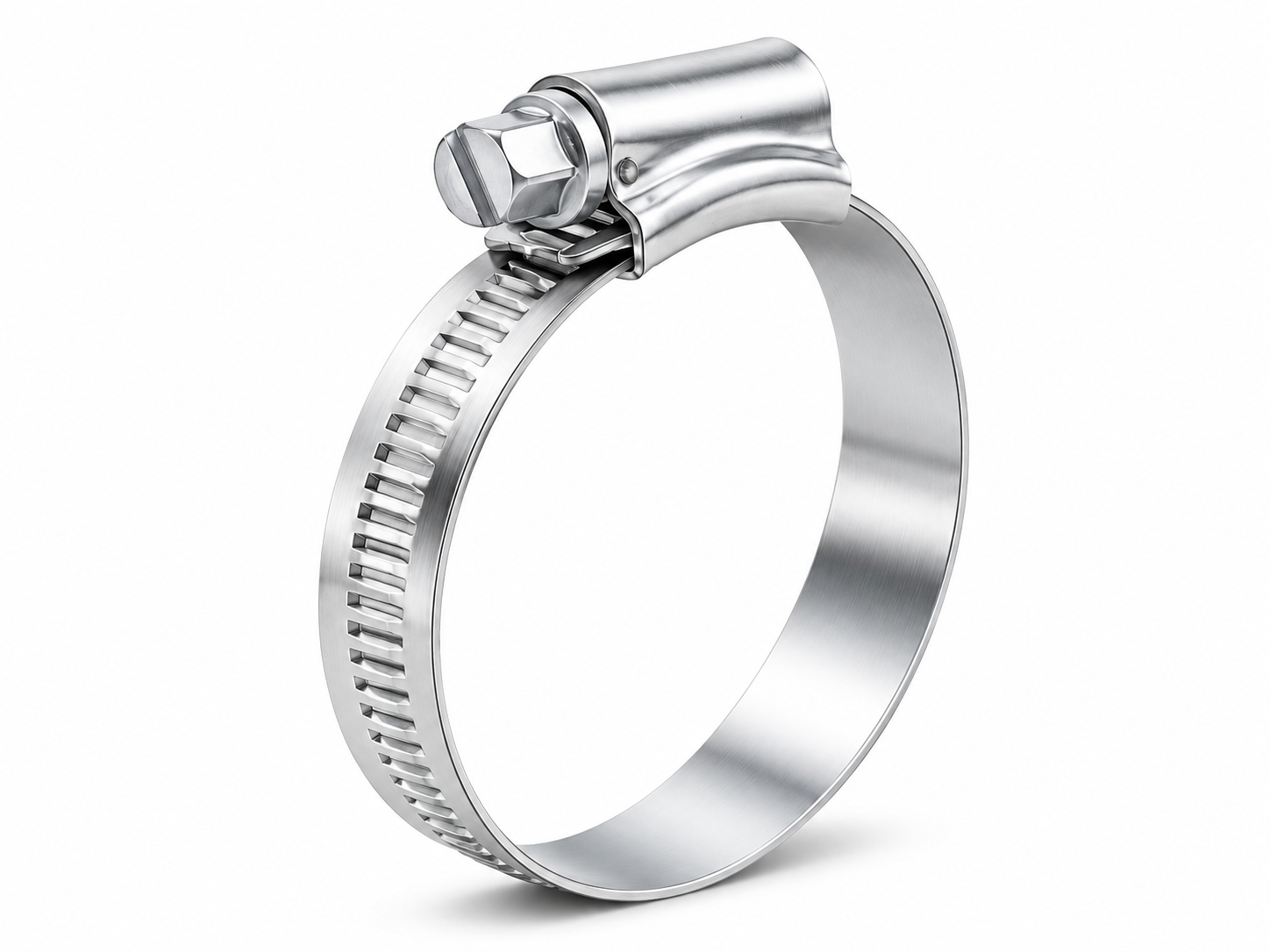
This British-type hose clamp uses a riveted housing and a non-perforated band. Turning the screw adjusts the clamping diameter. For a hose-to-fitting joint, check assembled outside diameter, clamping land width, and clearance around the riveted housing.
The riveted attachment secures the housing to the band. The housing supports the worm screw and guides band movement. The screw engages the formed thread on the outside of the band to tighten the clamp. Confirm the attachment details, number of rivet points, and outer dimensions on the part drawing.
The non-perforated band provides a continuous inner contact surface at the clamping location. Candidate applications include automotive coolant lines, heater hoses, and general equipment hose joints. Assess hose material, wall thickness, hardness, fluid, operating pressure, temperature, and vibration.
Seat the hose to the specified depth and check both assembled outside-diameter tolerance limits against the selected part’s clamping range. Select a band that fits fully on the clamping land and check clearance at the housing and band tail. Confirm the band, housing, and screw materials and finishes by part number.
Seat the clamp squarely on the designated clamping land and locate it relative to the fitting bead as shown on the drawing. Orient the screw for full driver or socket engagement and tighten to the torque approved for the part and assembly. Recheck the torque setting when fastener material, finish, or lubrication changes.
After installation, check the riveted attachment for looseness, cracks, or abnormal deformation. Verify that the housing is seated securely and the screw engages correctly. Check band position and inspect the hose for cuts or excessive extrusion. Before production, trial-fit assemblies at both outside-diameter tolerance limits and verify sealing, pull-off resistance, or performance after thermal cycling as required.
Provide the Towin part number or specify the clamping range, band width, riveted housing configuration, component materials, screw head, and quantity. For new applications, include hose and fitting drawings, tool approach, available clearance, and service conditions.
You can get a price or send us any questions to get any information you would like to know, and we will reply to you as soon as possible.